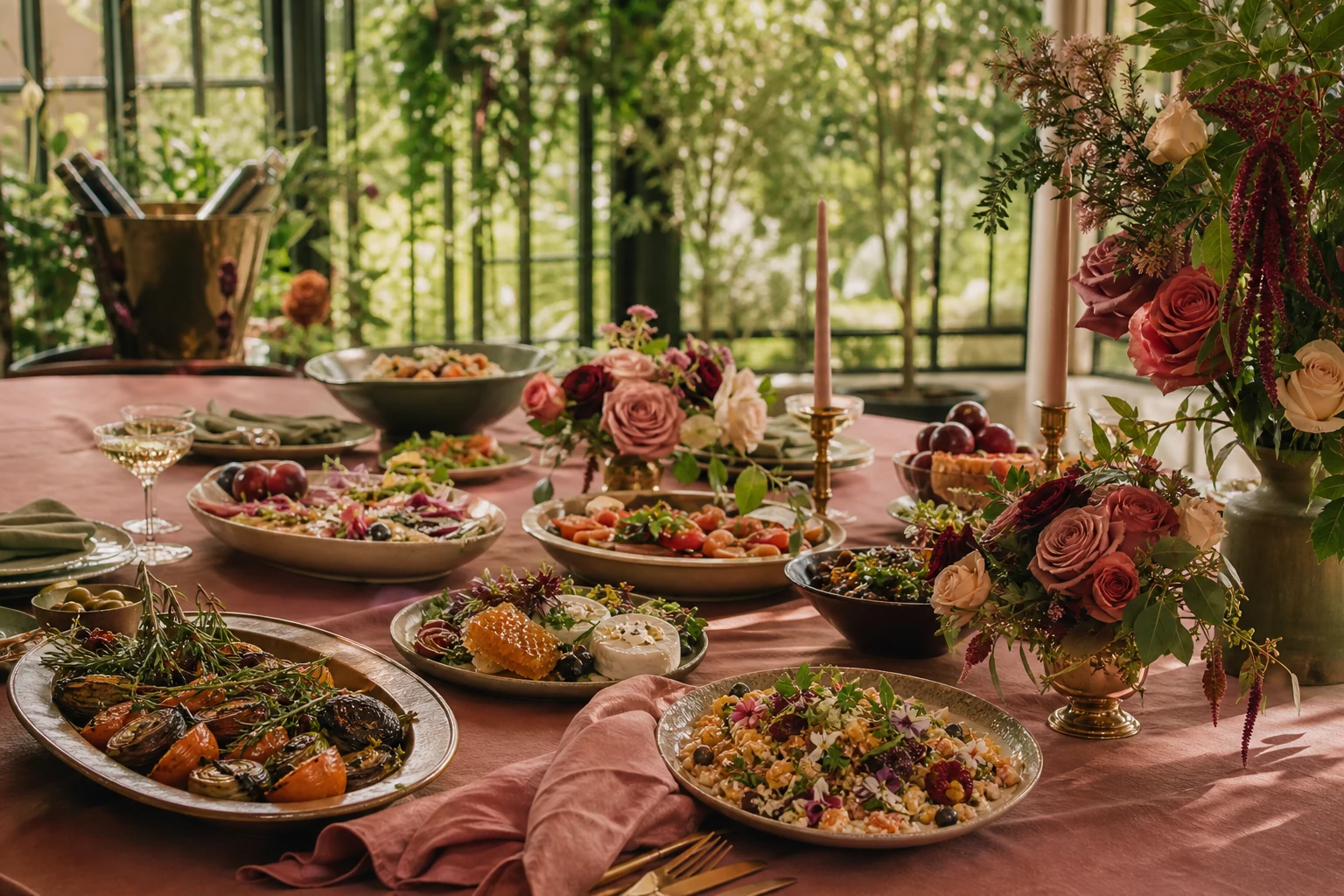
Working context
A memorable menu is rarely the longest one. It has a point of view: a season, a mood, a handful of flavors that belong together. That direction lets you say no to dishes that are merely impressive and yes to those that make sense on this table, for these guests, on this day. Without it, planning turns into collecting.
This guide offers a way to find that direction and shape it into a sequence of welcome, share, anchor and linger. The dishes mentioned are hypothetical examples of thinking, not recipes or recommendations, and nothing here describes a service we provide. You will need a rough guest list, a sense of the venue and an honest view of how much cooking and carrying you are willing to do.
SECTION 01Begin with the occasion, the season and the room
Write three short answers: what is the occasion, what is in season where you are, and how will people eat? A standing evening drink calls for food held in one hand, while a long seated lunch invites plates passed across the table. Seasonal ingredients are usually easier to source and more satisfying to eat, though you should check availability close to the date rather than assuming. From these answers, choose a direction in a sentence, such as bright and green for a spring afternoon, or slow and warming for a cold evening. Every dish should be able to explain itself against that sentence. If a favorite does not fit, it may belong at another gathering.
SECTION 02Shape a sequence rather than a pile
Think of the meal as four movements. Welcome is a first bite and drink that guests can enjoy without instruction. Share offers varied plates with enough contrast in texture, temperature and weight that nothing competes. Anchor is the central moment, appropriate to the scale and style of the gathering. Linger is a gentle ending that lets conversation continue. In a hypothetical supper for eight, one cool dish, one warm dish and one crisp element in the sharing course will feel more generous than six similar ones. Count what you can prepare ahead and what needs attention at the last minute, and keep the last-minute list short so the host remains with the guests.
SECTION 03Plan for varied guests without losing the thread
Guests arrive with preferences, beliefs and sometimes medical needs. Ask them early and plainly about anything that affects what they can eat, and take answers about allergies seriously, since they can be a matter of health. Rather than creating a separate lesser meal, aim for several dishes that many people can enjoy, and label ingredients clearly. Be honest about what you can guarantee in a home kitchen; if a guest has a serious allergy, speak with them or their clinician about how to proceed. Remember that variety also means contrast: offer something light, something rich and something plain. A coherent menu can be generous and flexible at the same time.
Checks to carry into the decision
- Write the occasion, the season and the way people will eat in three short answers.
- Summarize your menu direction in one sentence and test each dish against it.
- Sketch welcome, share, anchor and linger and assign at least one dish to each.
- Check availability of seasonal ingredients close to the date, not weeks before.
- Ask guests about allergies and dietary needs early, and record their answers.
- Label dishes with their main ingredients so guests can decide for themselves.
- Limit last-minute tasks to a short list that a single person can manage calmly.
How to get the most from it
Read menu direction first if you are still deciding what to serve, gathering flow when you are picturing the room, and host notes in the final week before the day. Keep a single page of decisions beside you and write the answers to each question as you go.
Common questions
Questions readers ask
How many dishes are enough?
Fewer than most hosts expect. Think in terms of movements rather than counts, with a few well-chosen dishes for each. More variety adds work and often reduces quality. If guests are eating for a long period, spread the courses out over time instead of increasing the number at once.
What if guests have conflicting dietary needs?
Start by finding out what each need actually is, since a preference and a medical requirement are different. Build a few dishes that suit as many people as possible, label them, and talk privately with anyone whose needs are serious. For health questions, they or their clinician are the right authority.
Should the menu follow trends?
Only if it suits your guests and your kitchen. A familiar dish made well usually beats a fashionable one made nervously. Let the season, the occasion and your confidence set the direction. If you want to try something new, place it where a small stumble will not affect the whole meal.
Bringing it together
Menu direction is a way of making fewer decisions, better. With a clear sentence about the table, a sequence for the evening and honest attention to your guests, the choices tend to fall into place. Write your plan down, test the riskiest dish ahead of time, and check food-safety rules with your local official authority.
These guides are general hosting and menu-planning ideas from an independent publication and are not food-safety, allergy or medical advice; check food-safety rules with your local official authority and ask guests or a qualified professional about dietary and health needs.